Background
Will Dryden is a pilot whose doodle had nine puppies — every one of them got mats, every time the groomer's answer was to shave them. He built the product he wished existed.
When I joined, the brand didn't exist yet. I worked as part of a small team — a senior designer, a project manager, and a Shopify developer. The design was entirely mine. The senior designer was there for guidance and to validate my decisions.
I worked closely with Will through weekly calls — shaping positioning, reviewing copy, deciding what to prioritise. My scope covered everything: brand and visual system, Shopify website, all seven product pages, Amazon listings, Instagram content, and campaign creative for Black Friday, Christmas, and New Year.
Three months to build it all. Two weeks to each campaign. I stayed intentional about what had to be right before launch and what could wait.
The core problem
Trust was the real brief
People buying pet care products online are making an emotional decision. They're worried about their dog. They're skeptical of new brands. They've been burned by products that promised results and didn't deliver.
The real design challenge was: how do you build enough trust in 10 seconds to get someone to put this in their cart?
The secondary challenge was conversion architecture — how do you structure a Shopify store and Amazon listing so that the path from "I'm curious" to "I'm buying" has as little resistance as possible?
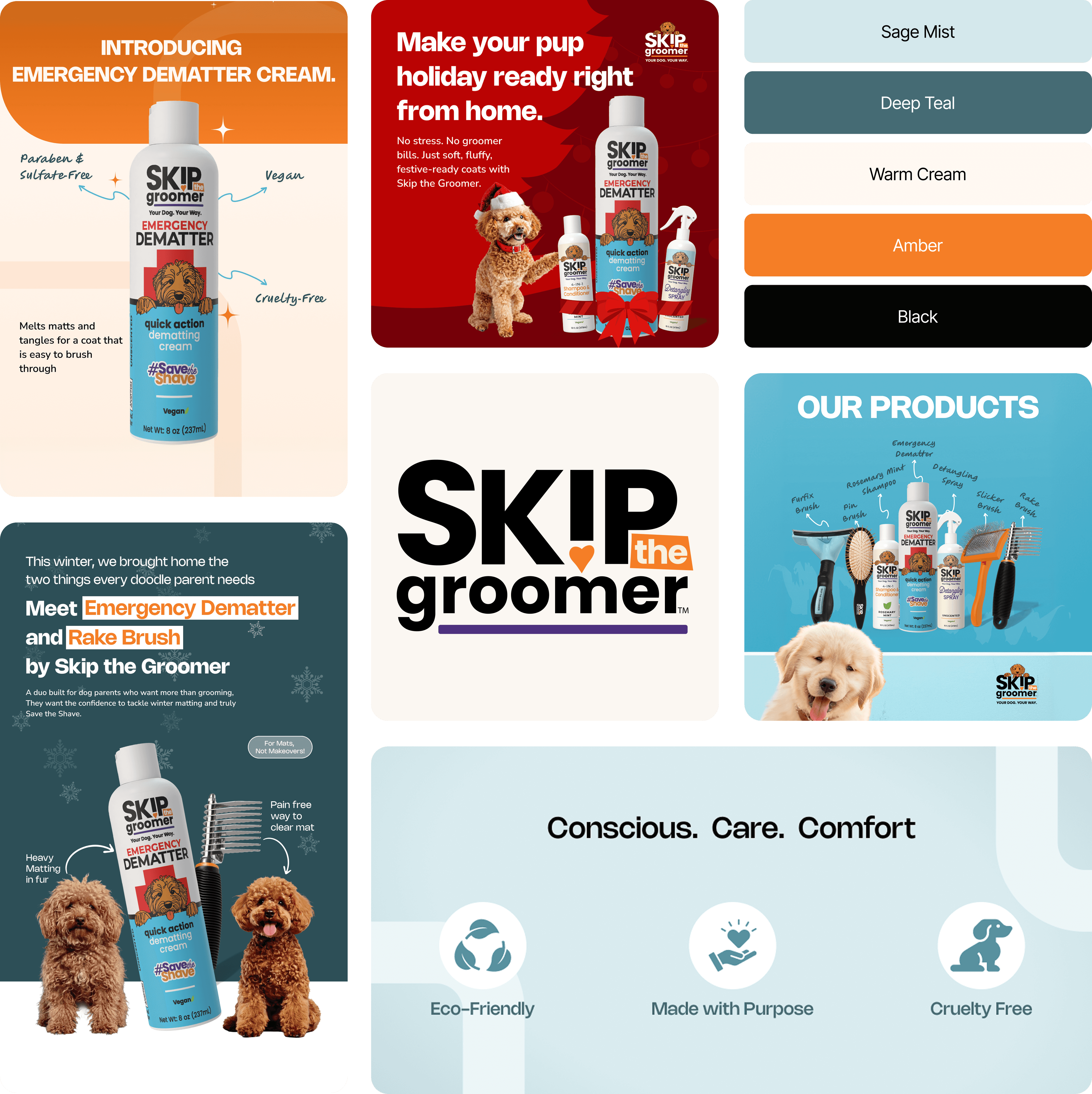
What I worked on
Website
Homepage, Shop, Product pages, and About Us.
Designed through Shopify implementation and working with developers to make sure design decisions translated into a functional and trust-building experience.
Amazon Listings
Main images, lifestyle shots, and A+ content.
My biggest responsibility was the primary revenue channel at launch. Designed to drive discovery, conversion, and credibility from zero reviews.
INSTAGRAM CONTENT
Posts, carousels, and stories.
Built a repeatable content system which could be used independently - focused on consistency and clarity, not one-off designs.
CAMPAIGN CREATIVE
Black Friday, Christmas, and New Year.
Was part of planning discussions, shaping how each campaign was positioned, what to highlight, and how to align it with the brand.
Design decisions
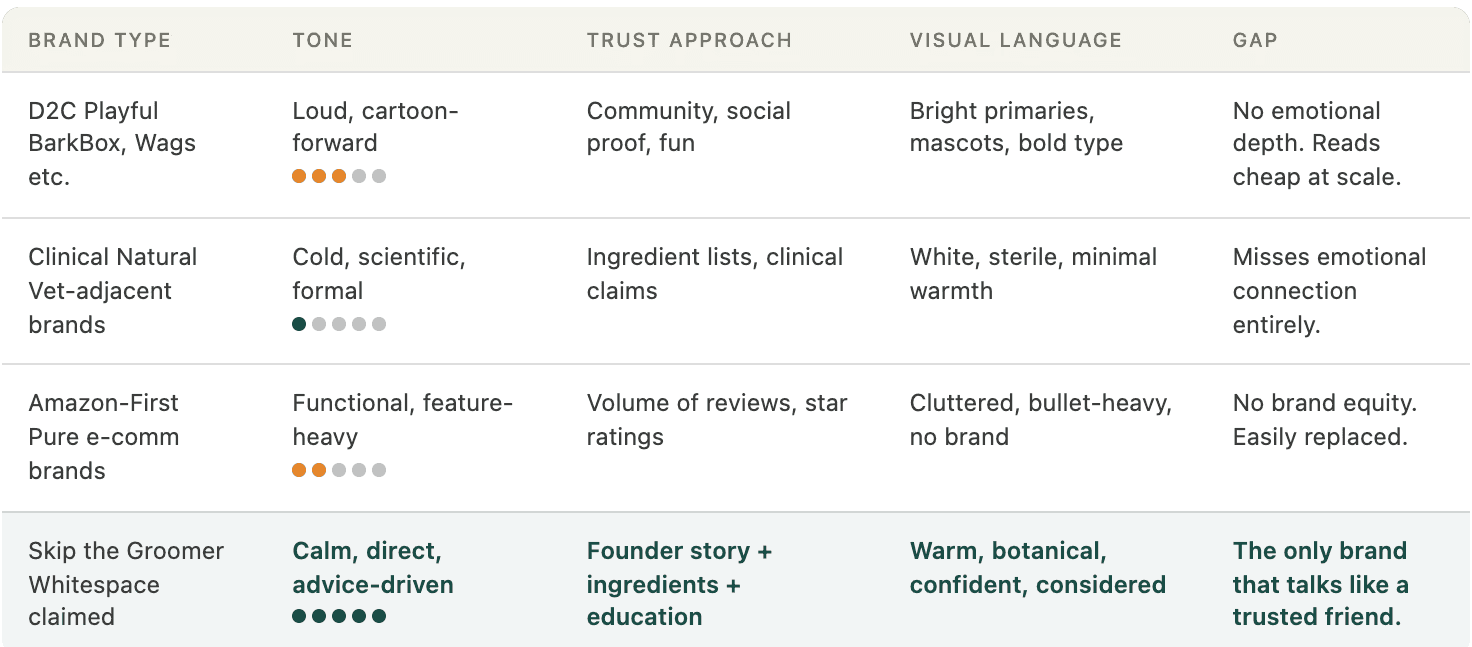
The biggest challenge was figuring out what kind of brand this needed to be. The pet care market usually leans in two directions, overly clinical or overly playful, and neither felt right here. I decided early on that Skip the Groomer should feel like advice from someone who actually owns a doodle, calm and direct.
The brand voice came from listening to Will talk about his dogs. Lines like “Save the Shave™”, “Your Dog. Your Way.” and “Confidence Starts With Their Coat” came directly from those conversations. I captured them in a structured messaging framework and locked them in early so every surface, from the website to Amazon and Instagram, spoke the same language from day one.


01
Reframing Emergency Dematter around when it’s actually used
01
Choosing an earthy, calm palette against the entire category
Most pet grooming brands default to bright primary colors — blues, yellows, reds. It reads energetic and approachable but it also reads cheap at scale. Skip the Groomer's product was plant-based, natural, and premium, and the visual language needed to match that promise rather than contradict it.
I pushed for earthy greens and warm neutrals. Colors that feel botanical and trustworthy rather than synthetic and loud. The founders initially wanted something brighter. I pulled up competitor packaging and asked them which brand they'd trust with their dog's sensitive skin. The palette decision made itself after that conversation.
01
Treating the About page as a trust surface
For an unknown DTC brand, buyers check the About page far more often than most brands expect. Not because they want the founder's story, but because they want to know if this is a real company or a dropship operation. That skepticism lives on the About page, and most brands completely ignore it.
I designed the page to lead with mission and follow immediately with ingredient transparency. It was the brand's single most credible differentiator, and it needed to be front and center where people would actually see it.
32.3% organic sales in the first month suggests that the brand and trust layer played a meaningful role. When users feel trust, they are more willing to try a new product.
How I worked
AI was part of this project from day one — not to generate outputs, but to pressure-test thinking and move faster through ambiguous problems in a compressed timeline.
01
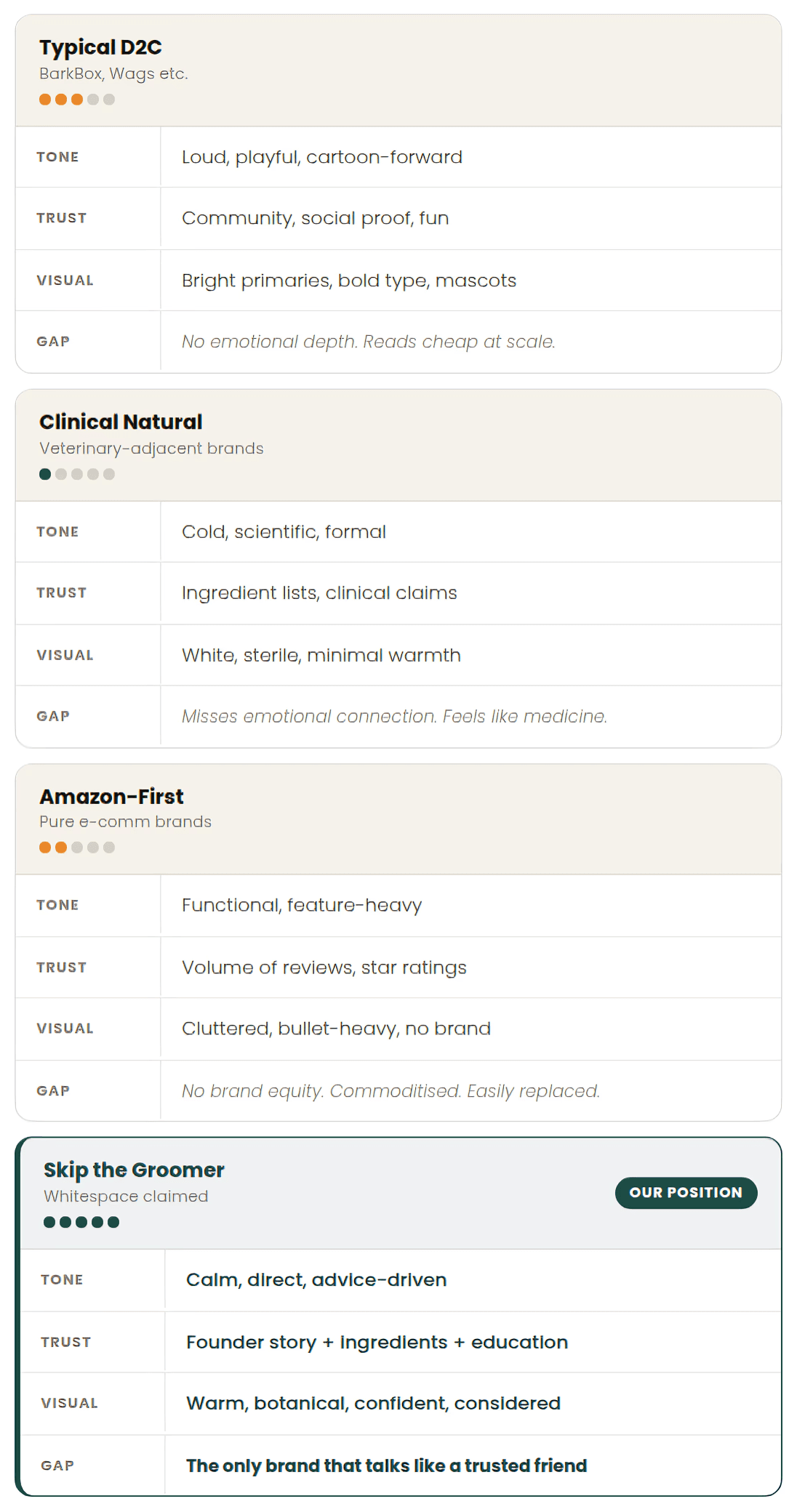
Mapping competitive positioning before any visual work
I used Claude to go through what every pet grooming brand was saying. Almost all of them sounded the same. That gap — calm, botanical, trustworthy — became the entire creative direction before a single pixel was touched.
02
Anticipating buyer objections before they surfaced
I asked Claude to think like a skeptical buyer. "What are your top five reasons not to buy this?" Every answer became a design decision — that's why trust signals sit above the fold instead of buried at the bottom.
03
Every decision was still mine
AI made me faster. It didn't make a single decision. Palette, CTA, page structure, what stayed and what got cut — all of that was judgment the tool didn't have.
Instagram & campaigns
I built a repeatable content system across Instagram and campaigns so the brand could stay active without needing new creative direction every week.
Instead of treating social content as promotion alone, we used it to educate users, reinforce trust, and make products easier to understand in real-life grooming situations.
Campaigns were framed around specific customer mindsets rather than generic discounts. Black Friday leaned into “Save the Shave”, Christmas focused on gifting, and New Year around building better grooming habits.
The holiday period from December 10 to 31 generated $16,216, which was nearly half of the total revenue.
Results
In the first seven weeks after launch, Skip the Groomer went from manufactured products with no digital presence to a live multi-channel brand across Amazon, Shopify, Instagram, and paid campaigns.
The launch validated both the product positioning and the demand around Emergency Dematter.
Generated $35,895 in total revenue between Nov 17 – Jan 4
Revenue grew from $1K in week one to $6.4K by week four after campaign rollout
Emergency Dematter became the breakout product, generating $23,418 from 1,050 units sold
Holiday campaigns between Dec 10 – 31 generated $16,216, contributing nearly half of total revenue
32.3% of sales came organically, showing early brand pull beyond paid acquisition
The first launch proved there was clear demand around the product category and established a strong foundation for future iteration and growth.
POST-LAUNCH INSIGHTS
Amazon became the primary purchase channel during launch, generating $35,348 in revenue.
The Shopify site generated lower direct revenue, but it played a different role in the ecosystem: introducing the brand, building trust, and supporting traffic coming from Instagram, paid ads, and organic discovery.
The conversion data revealed a clear pattern. Users who already had context around the brand converted significantly better than cold traffic.
Instagram traffic converted at 1.85%, while Facebook paid traffic converted at 0.39% despite much higher volume.
That gap suggested the brand experience was working, but the website needed stronger conversion-focused flows for first-time users arriving without context.
Reflection